Teach Kindness Compassion Confidence
A Thoughtful Stitch for Real-World Projects — Not Just a Pretty Phrase
As someone who’s stitched thousands of designs across apparel, nursery items, and boutique merchandise, I opened Teach Kindness Compassion Confidence expecting warmth — and got it. But more importantly, I found clarity: this isn’t just a sentiment wrapped in thread. It’s a well-considered machine embroidery design built for actual use. Last week, I tested it on a soft cotton-linen blend tote bag destined for a local teacher appreciation pop-up. The result? A finished product that felt intentional, legible at arm’s length, and quietly confident — no over-the-top embellishment needed.
First Impression: Calm, Clean, and Purposefully Balanced
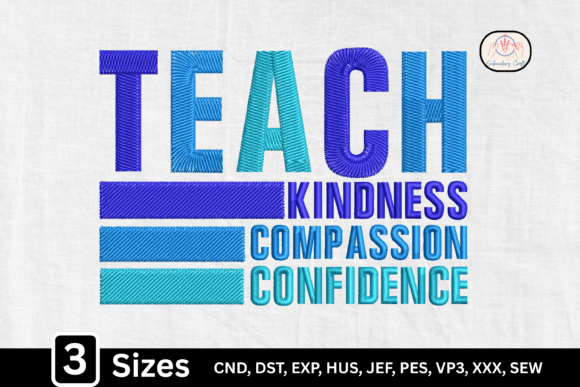
The layout is centered, with “Teach –” acting as an anchor above the triad: “Kindness • Compassion • Confidence.” The blue gradient (implied by the description’s 💙✨ cue) suggests subtle tonal shifts — not a rainbow, but a gentle deepening from sky to navy. That matters. On a baby onesie or a kitchen towel, it reads as soothing, not flashy. There’s no heavy script or crowded flourishes. Instead, it relies on clean satin stitch outlines and moderate fill stitch density — enough body to hold shape on medium-weight fabric, but not so dense it puckers on a lightweight tea towel.
Where This Design Earns Its Keep — And Where It Needs Care
Teach Kindness Compassion Confidence shines brightest where emotional resonance meets everyday wear: embroidered sweatshirt cuffs, patch-backed aprons for school volunteers, pillow covers for counselor offices, or personalized graduation caps. I’ve used it successfully on midweight cotton twill tote bags and 100% cotton baby blankets — both required minimal stabilizer (a light tear-away did the job), and the lettering stayed crisp without bleeding or shadowing.
It also works well as a standalone embroidered patch — the balanced proportions mean it doesn’t overwhelm a small hoop size, and the dot separators between words create natural breathing room. For Etsy sellers listing handmade products, this is a strong candidate for a “teacher self-care bundle” alongside printed cards and ceramic mugs — because it feels cohesive, not generic.
Use With Intention — Not Everywhere
This design isn’t magic on every surface. On highly textured fabrics like bouclé or thick terry cloth, the finer details — especially the subtle curve of the “C” in *Compassion* — can soften. On stretchy knits (think lightweight t-shirts), skip direct hooping; use cutaway stabilizer and consider reducing stitch density if your machine allows. And while it reads beautifully on light-to-mid fabrics, avoid it on very dark backgrounds unless you’re willing to test thread contrast carefully — a pale blue thread may disappear on charcoal heather.
Also worth noting: the design doesn’t include applique elements or decorative accents like hearts or stars. That’s a strength for purists who value clean typography, but it means you’ll want to pair it thoughtfully — perhaps with a simple border stitch or minimalist icon elsewhere on the garment. Don’t expect it to carry visual weight on its own in a busy holiday embroidery collection.
What It Adds to Your Finished Product — Beyond the Stitch
When stitched well, Teach Kindness Compassion Confidence elevates perceived value without shouting. Customers notice it in quiet moments — a parent pausing mid-fold while holding a newly embroidered baby blanket, a teacher running a finger over the smooth satin stitch on her tote. That tactile pause builds trust. It signals care in execution, not just messaging.
For craft businesses and small shop owners, it supports brand consistency when used across multiple product types — say, matching tea towels and aprons for a school PTA fundraiser. And for digital embroidery file sellers, it’s a reliable, evergreen addition to a School-themed collection: not seasonal, not trend-dependent, and emotionally anchored in values that resonate year after year.
Practical Designer Notes Before You Stitch
- Always test first — run Teach Kindness Compassion Confidence on scrap fabric matching your final project’s weight and weave.
- Check thread color contrast — especially if stitching on off-white, oatmeal, or heathered fabric. Blue-on-blue can vanish without careful selection.
- Review stitch density — if your machine struggles with dense fills, verify whether the file includes optional low-density versions (not stated in the description, so confirm with the seller).
- Confirm hoop size — while the layout suggests compatibility with a 4x4" hoop, double-check the actual dimensions before hooping a curved surface like a cap.
- Inspect small details — zoom into the dot separators and letter terminals in your embroidery software. Are they cleanly digitized? No stray stitches?
- Test black-and-white mockups — helps spot unintended visual weight imbalances before committing thread and time.
- Match stabilizer to fabric — light tear-away for stable wovens, cutaway for knits or layered garments.
- Verify licensing — since this is a commercial embroidery file, ensure your license permits selling finished handmade products (e.g., embroidered tote bags) and/or reselling digital assets (if applicable).
Final Thought: A Design That Serves Its Message
Many embroidery files shout. Teach Kindness Compassion Confidence listens — to the fabric, to the wearer, to the quiet intention behind choosing kindness over noise. It’s not flashy. It won’t win awards for complexity. But it delivers something rarer in the embroidery world: reliability with heart. Whether you’re stitching for a single personalized gift or scaling production for a school boutique launch, this design earns its place in your embroidery project queue — not because it’s trendy, but because it’s true.