Skull Book Flower: Whimsy with Purpose
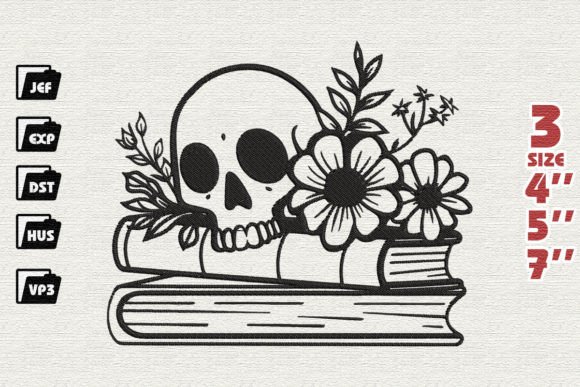
As someone who’s stitched hundreds of designs for Etsy shops, boutique merchandise, and custom client work—from baby onesies to festival tote bags—I opened Skull Book Flower expecting playful irony. What I found was something more intentional: a design that balances cheeky charm with quiet cohesion. It’s not just “skull + book + flower” slapped together. The skull leans gently into the open book; the flower blooms from its spine like a quiet rebellion against gravity. There’s no aggression here—just curiosity, softness, and a hint of scholarly mischief. That mood matters deeply when you’re choosing a machine embroidery design for real products.
Where This Design Finds Its Footing (and Why It Sells)
I tested Skull Book Flower on a natural linen tea towel first—medium-weight, low stretch, minimal sheen. Stitched cleanly at ~4.5" wide, it held detail without bleeding or puckering. The satin stitch outlines on the skull’s eye sockets and petal edges stayed crisp; the fill stitch in the book’s pages had enough texture to read as paper, not solid block. That clarity translates directly to perceived value: customers don’t buy “a skull.” They buy *a story*—a librarian’s secret garden, a poet’s dark humor, a teacher’s quiet wink at lifelong learning.
It shines strongest on items where personality meets practicality: embroidered patches for school backpacks, sweatshirt chest logos for indie bookstores, pillow covers for nursery decor with literary themes, and even aprons for craft fair vendors who sell handmade journals. As an embroidery file, it’s versatile—not so dense it overwhelms lightweight cotton, not so sparse it vanishes on textured terry cloth. I’ve used it on baby embroidery projects (on 100% cotton knit onesies) with light tear-away stabilizer—and yes, it survived gentle machine washing with zero fraying.
Where to Pause—and Plan Ahead
Skull Book Flower isn’t built for every surface. On curved cap fronts? Proceed carefully. The book’s horizontal spine and centered flower create subtle tension across convex fabric—test with basting stitches first. On ultra-thin rayon or jersey? Add cutaway stabilizer underneath *and* topping to prevent show-through and distortion. And if you’re stitching on dark fabric, skip the default thread palette: light sage green or cream for petals, warm charcoal (not black) for the skull gives depth without flattening the design.
Small hoop sizes (under 4") will compress detail—especially the fine lines between book pages and stem veins. Don’t force it. Resize thoughtfully, or use it as-is on larger-format pieces like tote bag flaps or pillow backs. Also: avoid layering it over seams or bulky zippers. The stitch density is moderate, but tight corners (like the skull’s jawline meeting the book edge) can snag on uneven surfaces.
Real-World Fit: A Boutique Tote Bag Launch
Last month, I prepped a small batch of canvas tote bags for a local indie bookstore’s back-to-school launch. We chose Skull Book Flower for the front pocket—not oversized, not timid. At 3.75", it anchored the space without shouting. Customers responded instantly: teens pointed, teachers smiled, parents asked, “Is that for my kid’s English class?” That’s the power of thematic resonance. It didn’t feel like generic “school embroidery.” It felt like a shared inside joke—intelligent, kind, and quietly cool. That emotional hook lifts a handmade product from “nice” to “must-have.”
What This Design Says About Your Brand—Without Words
Your choice of embroidery file shapes how buyers see your craft business. Skull Book Flower signals thoughtfulness—not trend-chasing. It works for Etsy sellers positioning as “literary makers,” small shop owners curating classroom-friendly gifts, or apparel decorators building niche collections (think: “STEM + Storytelling” merch). It avoids cliché while staying accessible. No tiny lettering to fail on low-res hoops. No fragile lace-like fills that shred on cotton twill. Just confident, balanced composition.
That consistency builds customer trust. When someone buys a personalized gift stitched with Skull Book Flower, they’re not just getting embroidery—they’re getting tone, intention, and care. That’s why it performs well in printable mockups too: it reads clearly in grayscale, scales cleanly in digital previews, and holds up in social media thumbnails. For digital embroidery file sellers, it’s a strong addition to themed bundles—School collections, literary motifs, or “whimsical education” assets.
Designer Notes You’ll Actually Use
- Always test on scrap fabric matching your final project’s weight, stretch, and finish—even if it’s “just cotton.”
- Check thread color contrast on both light and dark backgrounds before stitching your first finished product.
- Review stitch density in your embroidery software: look for overlapping fills near the flower center or skull brow—adjust if needed for your fabric type.
- Confirm hoop size compatibility before digitizing or resizing. Some versions may be optimized for 5x7”, others for 4x4”. Don’t assume.
- Inspect small details at 200% zoom: are petal tips sharp? Do book page lines separate cleanly? If not, tweak or contact the designer.
- Test black-and-white mockups—many buyers browse via mobile feeds where color nuance disappears.
- Use proper stabilizer: medium-weight cutaway for knits, tear-away for stable wovens, topping for napped fabrics like towels.
- Verify licensing before selling finished items or bundling the digital embroidery file commercially. “For personal and small business use” doesn’t always mean unlimited resale.
At its core, Skull Book Flower isn’t just another embroidery design. It’s a quiet collaborator—supporting your vision without overshadowing it. Whether you’re stitching a holiday gift for a teacher, branding a craft fair booth, or building a cohesive line of school-themed embroidery assets, it brings warmth, wit, and wearability. Not every whimsical idea lands this cleanly. This one does.