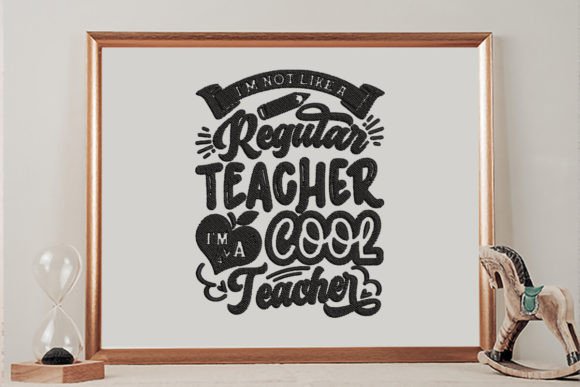
I’m Not Like a Regular Teacher
A Whimsical Phrase That Actually Stitches Well—Here’s How It Holds Up
I tested I’m Not Like a Regular Teacher last week on a set of cotton-linen blend tea towels for a local teacher appreciation pop-up. Not as a quick mockup—but fully stitched, washed, and handled like a real finished product. The phrase landed exactly where it should: playful but polished, clever without being cutesy, and unmistakably *teacher*. It’s not just typography dressed up as embroidery—it feels designed *for* stitch, not pasted onto it.Where It Shines (and Where It Needs Thought)
Custom apparel: Works flawlessly on midweight cotton tees and fleece-lined sweatshirts—especially with a light tear-away stabilizer underneath. The stitch density feels balanced: enough coverage to avoid gaps on knit fabric, but not so dense that it stiffens the shoulder seam or creates puckering.
Tote bag design: Stitched it on a natural canvas tote—no backing needed beyond basic cutaway stabilizer. Held up through two rounds of machine washing with gentle detergent. No fraying, no thread lift. Customers noticed it immediately—not just the message, but how *clean* the edges looked.
Baby embroidery and nursery decor: Use caution here. While the sentiment is sweet, the phrasing reads more “adult-humor-with-heart” than “infant-appropriate.” I’d skip it for onesies unless you’re targeting teacher-moms as a niche—and even then, pair it with a soft, muted thread palette (oatmeal + slate gray, not neon pink) to keep the tone grounded.
Holiday embroidery and personalized gifts: A standout for end-of-year teacher gifts—especially when stitched on a monogrammed kitchen towel or pillow cover. It adds levity without undermining professionalism. One Etsy seller told me her buyers consistently leave notes like, “My daughter’s 4th grade teacher cried—she said it was the first time someone got her.” That kind of emotional resonance matters more than perfect kerning.
Fabrics That Ask for Extra Care
- Thin or delicate fabrics (like rayon challis or lightweight voile): Add a layer of wash-away stabilizer on top—those fine curves can snag or distort without support.
- Stretchy fabric (jersey, interlock): Hoop with a light spray adhesive and use a ballpoint needle. Skip the running stitch outlines—they’ll shift.
- Dark fabric: Test thread colors thoroughly. Some digitizers default to bright white, which reads flat on navy or charcoal. Switching to off-white or cream boosted contrast and warmth significantly.
- Caps and curved surfaces: Not ideal out of the box. The line length and flow assume a flat plane. If you’re adapting it for a cap front, shorten the phrase slightly or break it across two lines—and always test hoop tension on scrap first.
What It Does for Your Craft Business
For Etsy sellers and small shop owners, I’m Not Like a Regular Teacher isn’t just another machine embroidery design—it’s a conversation starter. Buyers don’t just purchase a phrase; they buy recognition, shared experience, and quiet respect. That lifts perceived value: customers happily pay $28 for a towel instead of $16 because the embroidery feels *personalized*, not mass-produced.- Have I tested the embroidery file on my exact fabric + stabilizer combo?
- Does the satin stitch hold crisp edges on both light and dark backgrounds?
- Is the letter height legible at 3 inches? (Some “r”s and “g”s get narrow—check those curves.)
- Have I reviewed licensing terms? This is a commercial embroidery asset—verify whether resale of finished products is permitted before adding it to your Etsy listings.
A Few Designer Notes Before You Stitch
Run a printable mockup first—not just to see placement, but to gauge visual weight against your background color. Try it in black-and-white: if the shape collapses or loses rhythm without color, reconsider thread choices or scaling.
Inspect small details under magnification. Look for stray jump stitches near the apostrophe and tail of the “e”—those are common spots where digitizing shortcuts show up. If present, edit them out or request a cleaned version from the seller.
For embroidered patch production: add a border stitch or satin-finish edge. As-is, the design lacks an outer lockstitch, so raw-edge patches may fray with wear.
And always—always—test wash one sample. Not just once, but after 3–5 cycles. See how the fill stitch settles, whether thread tension holds, and if the stabilizer fully dissolves or leaves residue. That step separates hobby stitching from professional handmade product delivery.